Why Coriolis Meters are Essential for Two-Phase Immersion Cooling | ASMIK
Application Guide

Why Coriolis Meters are Essential for Two-Phase Immersion Cooling

Mass flow, density, and temperature — measured simultaneously in a single instrument. The precision that high-density data center cooling demands.

Explore the Solution ↓
The Challenge

Two-Phase Immersion Cooling Demands Precise Fluid Monitoring

In two-phase immersion cooling, servers are submerged in a low-boiling-point dielectric fluid. As heat is absorbed, the coolant boils and transitions from liquid to vapor — a highly efficient process that achieves PUE as low as 1.01, but one that requires continuous multi-parameter monitoring to maintain optimal performance.

🔄

Phase Change Tracking

The dielectric coolant continuously shifts between liquid and vapor states. Accurately tracking density changes in real time is essential to understand the coolant's current phase ratio and ensure efficient heat absorption.

📊

Mass-Based Flow Control

Volume-based flow meters fail in two-phase environments because gas entrainment distorts readings. Only mass flow measurement provides a true, density-independent reading of coolant circulation.

📐

Compact Installation

Immersion cooling tanks feature dense, space-constrained plumbing. Instruments that require long straight pipe runs upstream and downstream are impractical in these environments.

How It Works

Coriolis Measurement Principle

A Coriolis meter derives mass flow, density, and temperature from the behavior of vibrating measurement tubes — with no moving parts and no dependence on fluid properties.

Coriolis mass flow meter working principle diagram showing Coriolis force acting on fluid in vibrating measurement tubes, with phase shift waveform at zero, low and high flow states
Fig. 1 — Working principle of the Coriolis mass flow meter. The Coriolis force generates a phase shift in the vibrating tubes proportional to mass flow rate.

Tube Excitation

A driving coil causes the measurement tubes to oscillate at their natural resonant frequency in a controlled sinusoidal pattern.

Coriolis Force & Mass Flow

As dielectric coolant flows through the vibrating tubes, its inertia creates a Coriolis force that twists the tubes — producing a phase shift between inlet and outlet sensors directly proportional to mass flow rate.

Density from Resonant Frequency

The resonant frequency shifts as fluid density changes. When the coolant transitions from liquid to vapor during boiling, the density drops and the frequency change reveals the exact fluid density in real time.

Integrated Temperature Sensing

Built-in RTD temperature sensors measure fluid temperature simultaneously, enabling complete thermal state monitoring from a single instrument.

Product Structure

FCC300 / FCC800 Coriolis Mass Flow Meter

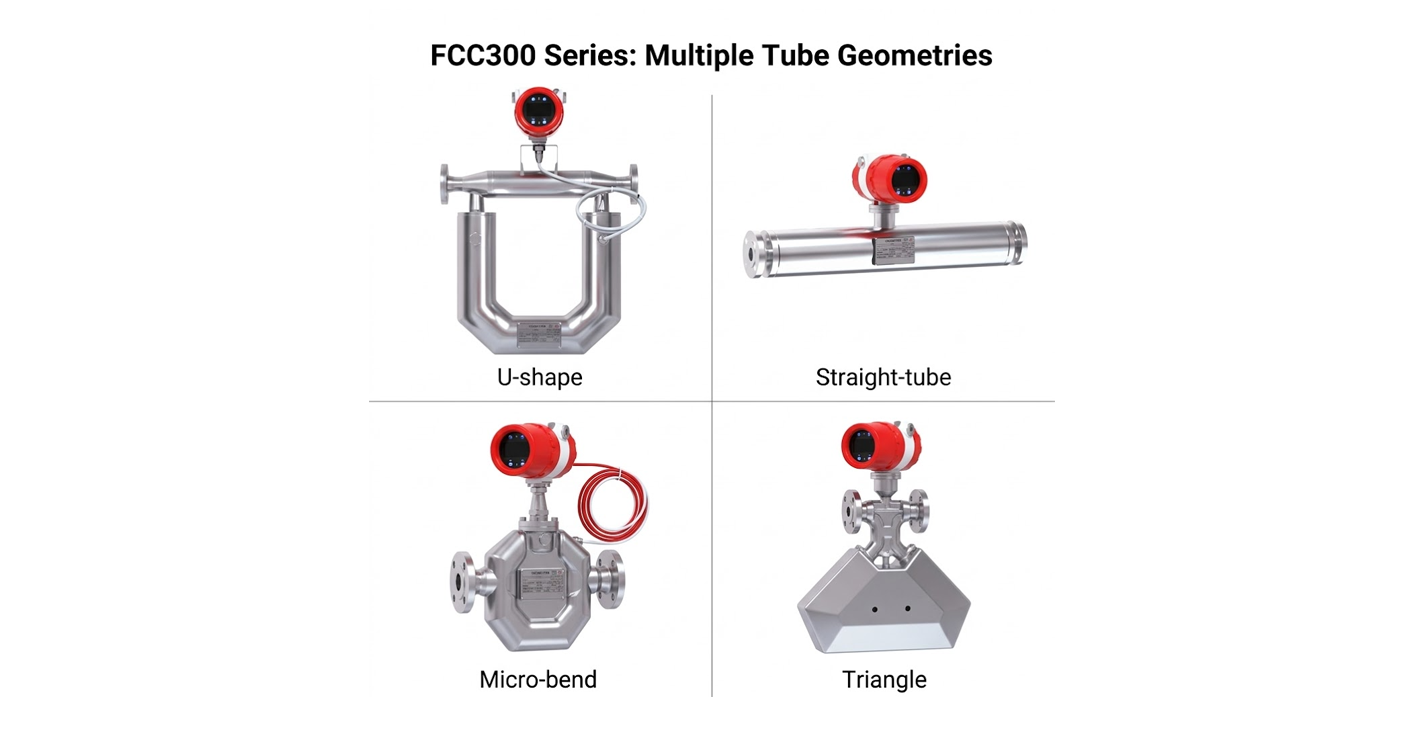
Available in multiple tube geometries — U-shape, straight-tube, and micro-bend — to match the specific flow range, pressure drop, and installation constraints of your immersion cooling system. All models feature 304SS/316SS stainless steel wetted parts fully compatible with fluorocarbon-based dielectric fluids.

ASMIK FCC300 FCC800 Coriolis mass flow meter product structure showing U-shape straight tube and micro-bend sensor configurations in stainless steel housing
Fig. 2 — Product structure of the ASMIK Coriolis mass flow meter, showing available sensor configurations for data center cooling installations.

Key Advantages for Two-Phase Immersion Cooling

01

Simultaneous Multi-Parameter Output

Mass flow, volume flow, fluid density, and temperature from one device. A single installation point tracks coolant flow rate and detects liquid-to-vapor transitions by monitoring density shifts.

4 parameters, 1 device
02

True Mass Flow — Immune to Phase Changes

Unlike volumetric meters, Coriolis meters measure mass directly. When gas bubbles from boiling coolant enter the measurement section, the reading remains valid — critical for loops where vapor fraction fluctuates constantly.

Accuracy: 0.15%
03

Real-Time Phase State Detection

Continuous density monitoring at ±0.001 g/cm³ precision detects exactly when the coolant transitions from liquid to vapor, enabling proactive thermal management and preventing dry-out conditions.

±0.001 g/cm³
04

Zero Straight Pipe Requirements

No upstream or downstream straight pipe runs needed. Directly installable in the tight, compact plumbing of immersion cooling tanks without flow conditioning.

0D / 0D pipe runs
05

Wide Temperature Range

Standard: -50°C to 200°C. Cryogenic: down to -255°C. Covers all common dielectric immersion cooling fluids including low-boiling-point fluorocarbon coolants (34°C–61°C boiling point).

-255°C to +350°C
06

Industrial Communication Protocols

4-20mA, pulse/frequency, RS485 (Modbus-RTU), and HART outputs enable seamless integration with BMS and DCIM platforms for automated cooling loop control.

RS485 / HART / 4-20mA
Technical Specifications

Complete Parameter Table

Technical parameters for the ASMIK FCC300/FCC800 Coriolis mass flow meters applicable to two-phase immersion cooling systems.

ParameterSpecification
Measuring VariablesMass Flow, Density, Temperature, Volume Flow
Flow Accuracy0.15% / 0.2% / 0.5%
Density Accuracy±0.001 g/cm³ or ±0.002 g/cm³
Temperature Accuracy±1°C
Density Measuring Range0.3 ~ 3.000 g/cm³ or 0.5 ~ 2.0 g/cm³
Medium Temperature (Standard)-50°C ~ 200°C
Medium Temperature (High Temp)Up to 350°C
Medium Temperature (Cryogenic)-200°C ~ -255°C
Output Signals4-20mA, Pulse/Frequency, RS485 (Modbus-RTU), HART
Protection RatingIP67
Explosion-ProofEx db ia IIC T6 Gb
Sensor Structure TypesU-shape, Straight-tube, Micro-bend
Sensor Material304SS / 316SS Stainless Steel
Straight Pipe RequirementsNone (0D upstream / 0D downstream)

System Integration: Coriolis Meter in a Two-Phase Immersion Cooling Loop

Two-Phase Immersion Cooling Loop with Coriolis Meter System diagram: servers immersed in dielectric fluid inside a tank, vapor rising to a condenser, condensed liquid returning through a Coriolis meter and pump back to the tank. Data output from the meter connects to BMS/DCIM via RS485/HART. IMMERSION TANK LIQUID LEVEL SERVER BOARDS VAPOR ↑ CONDENSER Vapor → Liquid CORIOLIS METER ṁ ρ T BMS / DCIM RS485 / HART / 4-20mA P PUMP VAPOR → LIQUID ↓ ← LIQUID RETURN ← TO TANK
Real-World Application

Field Installation & Deployment Scenarios

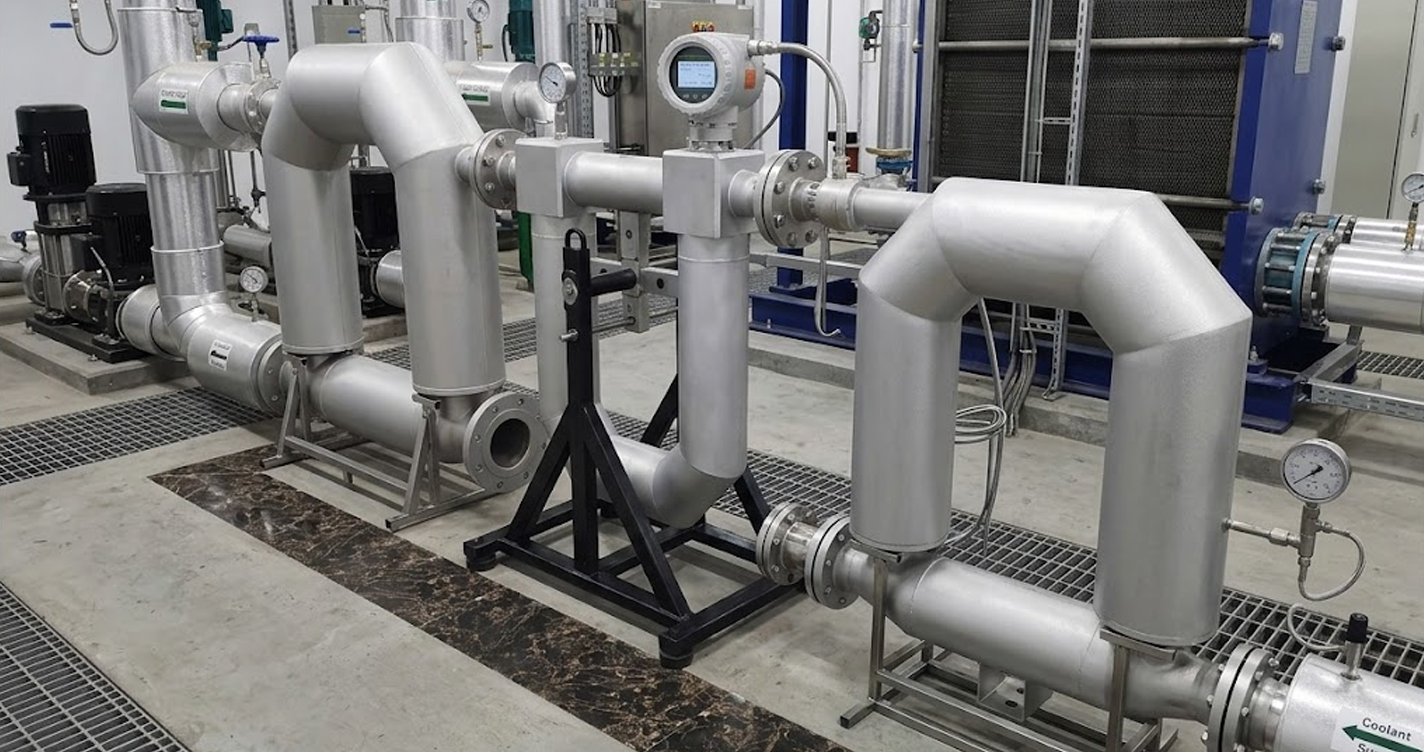
ASMIK Coriolis meters are deployed across hyperscale data centers, AI/HPC GPU cooling clusters, and edge computing sites — wherever precise two-phase coolant monitoring is required.

ASMIK Coriolis mass flow meter installed in industrial stainless steel piping for immersion cooling application, showing robust 304SS 316SS construction and compact installation without straight pipe runs
Fig. 3 — Field installation of the ASMIK Coriolis mass flow meter. The robust stainless steel construction and zero straight-pipe requirement enable compact integration into cooling infrastructure.
🏢

Hyperscale Data Center Tanks

Monitor coolant mass flow and phase state across multiple immersion tanks simultaneously. Detect imbalanced cooling distribution before thermal throttling occurs. RS485 Modbus-RTU enables centralized monitoring of dozens of measurement points.

AI / HPC GPU Cooling

High-power GPU clusters generating 600W+ per chip demand precise coolant dosing. Coriolis density monitoring prevents dry-out at chip surfaces by detecting vapor fraction changes before they become critical.

📡

Edge Computing Deployments

Space-constrained edge sites benefit from zero straight-pipe requirements and compact form factor. Remote monitoring via RS485/Modbus enables reliable unmanned operation in distributed locations.

FAQ

Frequently Asked Questions

Coriolis meters measure mass flow directly, independent of fluid density, viscosity, or phase state. In two-phase immersion cooling, the coolant constantly transitions between liquid and vapor — conditions that cause significant errors in vortex and ultrasonic meters. Additionally, the Coriolis meter provides simultaneous density measurement for real-time phase state monitoring that other meter types cannot offer from a single device.
The FCC300/FCC800 series provides mass flow accuracy up to 0.15%, density accuracy of ±0.001 g/cm³, and temperature accuracy of ±1°C. This precision detects small shifts in coolant density indicating the onset of boiling, enabling proactive thermal management.
Yes. With a standard operating temperature range of -50°C to 200°C and cryogenic variants down to -255°C, Coriolis meters accommodate dielectric coolants such as Fluorinert and Novec fluids (boiling points 34°C–61°C). The 304SS/316SS stainless steel wetted parts are fully compatible with fluorocarbon-based dielectric fluids.
The optimal installation point is on the liquid return line — after the condenser and before re-entry to the immersion tank. At this position, the meter monitors condensed liquid mass flow rate, density (confirming full condensation), and temperature, providing a complete picture of loop performance. Zero straight pipe requirements allow installation at any convenient point.
The FCC300/FCC800 carries IP67 ingress protection and Ex db ia IIC T6 Gb explosion-proof certification, meeting safety requirements of industrial-scale data centers. All-stainless-steel construction ensures long-term reliability in continuous-operation environments.
Get Started

Ready to Optimize Your Immersion Cooling System?

Contact ASMIK for technical consultation on Coriolis meter selection and sizing for your two-phase immersion cooling application.